Kurš datēja Theodora Komnene, Queen of Jerusalem?
Andronikos I Komnenos datēja Theodora Komnene, Queen of Jerusalem no ? līdz ?.
Theodora Komnene, Queen of Jerusalem
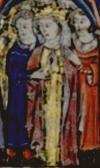
Theodora Komnene (Ancient Greek: Θεοδώρα Κομνηνή; born c. 1145) was a member of the Byzantine imperial Komnenos family who became queen consort of the crusader Kingdom of Jerusalem.
In 1158, Emperor Manuel I Komnenos arranged for Theodora, his 12-year-old niece, to marry King Baldwin III of Jerusalem as part of an alliance of the two Christian states requested by Baldwin's advisors. Although they were happy together, Theodora wielded no power as Baldwin's wife, and was widowed in 1162. She retired to Acre, the city she was to hold for life as dower.
In 1168, Theodora started a relationship with her kinsman Andronikos Komnenos and soon eloped with him, infuriating Manuel. They wandered through the Muslim-ruled Levant and had two children together, Alexios and Eirene. After some time spent in Georgia, they moved to Anatolia, where Theodora and her children were captured and brought to Manuel. Andronikos and Manuel reconciled, and Theodora spent the rest of her life with Andronikos in Paphlagonia. She presumably died before 1182, when he became emperor.
Lasīt vairāk...Andronikos I Komnenos
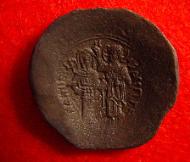
Andronikos I Komnenos (Greek: Ἀνδρόνικος Κομνηνός, romanized: Andrónikos Komnēnós; c. 1118/1120 – 12 September 1185), Latinized as Andronicus I Comnenus, was Byzantine emperor from 1183 to 1185. A nephew of John II Komnenos (r. 1118–1143), Andronikos rose to fame in the reign of his cousin Manuel I Komnenos (r. 1143–1180), during which his life was marked by political failures, adventures, scandalous romances, and rivalry with the emperor.
After Manuel's death in 1180, the elderly Andronikos rose to prominence as the accession of the young Alexios II Komnenos led to power struggles in Constantinople. In 1182, Andronikos seized power in the capital, ostensibly as a guardian of the young emperor. Andronikos swiftly and ruthlessly eliminated his political rivals, including Alexios II's mother and regent, Maria of Antioch. In September 1183, Andronikos was crowned as co-emperor and had Alexios murdered, assuming power in his own name. Andronikos staunchly opposed the powerful Byzantine aristocracy and enacted brutal measures to curb their influence. Although he faced several revolts and the empire became increasingly unstable, his reforms had a favorable effect on the common citizenry. The capture of Thessaloniki by William II of Sicily in 1185 turned the people of Constantinople against Andronikos, who was captured and brutally murdered.
Andronikos was the last Byzantine emperor of the Komnenos dynasty (1081–1185). He was vilified as a tyrant by later Byzantine writers, with one historian calling him "Misophaes" (Ancient Greek: μισοφαής, lit. 'hater of sunlight') in reference to the great number of enemies he had blinded. The anti-aristocratic policies pursued by Andronikos destroyed the Komnenian system implemented by his predecessors. His reforms and policies were reversed by the succeeding Angelos dynasty (1185–1204), which contributed to the collapse of imperial central authority. When the Byzantine Empire was temporarily overthrown in the Fourth Crusade (1204), Andronikos' descendants established the Empire of Trebizond, where the Komnenoi continued to rule until 1461.
Lasīt vairāk...