Kurš datēja Federica Montseny?
Germinal Esgleas Jaume datēja Federica Montseny no ? līdz ?. Vecuma starpība bija 1 gadus, 4 mēnešus un 7 dienas.
Federica Montseny
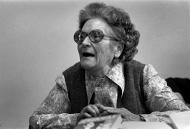
Frederica Montseny i Mañé (Catalan: [munˈsɛɲ]; 1905–1994) was a Spanish anarchist and intellectual who was a notable member of the CNT and served as Minister of Health and Social Assistance in the government of the Second Spanish Republic during the Civil War. She is known for being the first woman in Spanish history to be a cabinet minister and one of the first female ministers in Western Europe.
Following the defeat of anarchist forces in the Spanish Civil War, she managed to flee and enter into exile - continuing her anarchist militancy from abroad. Montseny was notably one of the main delegates at the Congress of Carrara (1968), one of the major anarchist congresses of the 20th century, where she represented the FAI.
She was also known as a novelist and essayist. She published about fifty short novels with a romantic-social background aimed specifically at women of the proletarian class, as well as political, ethical, biographical and autobiographical writings (see "García Guirao, Pedro (1988)" in "Further reading" below.)
Lasīt vairāk...Germinal Esgleas Jaume
Josep Esgleas i Jaume (1903–1981), commonly known by his pseudonym Germinal Esgleas, was a Catalan anarcho-syndicalist. He joined the National Confederation of Labour (CNT) at an early age, going on to teach at one of the organisation's rationalist schools in Mataró. After the proclamation of the Second Spanish Republic, he joined the Iberian Anarchist Federation (FAI) and began writing for La Revista Blanca, in which he advocated for a hardline stance against moderate syndicalism. During the Spanish Civil War, he formed a commission to purchase weapons for the Republic and was briefly considered for the role of Minister of Economy in the Catalan government. Towards the end of the war, he participated in a plot to oust the government of Juan Negrín. With the Nationalist victory, he fled to France with his wife Federica Montseny and their children. After spending years incarcerated in concentration camps and prisons, he was released during the Liberation of France. He then became one of the foremost leaders of the orthodox faction of the CNT and was elected as the organisation's General Secretary, a post he served in for most of its time in exile.
Lasīt vairāk...